“If people on the street are a problem for people who live in houses, what are they doing about that problem?” - Emile Lesch, Souper Trooper
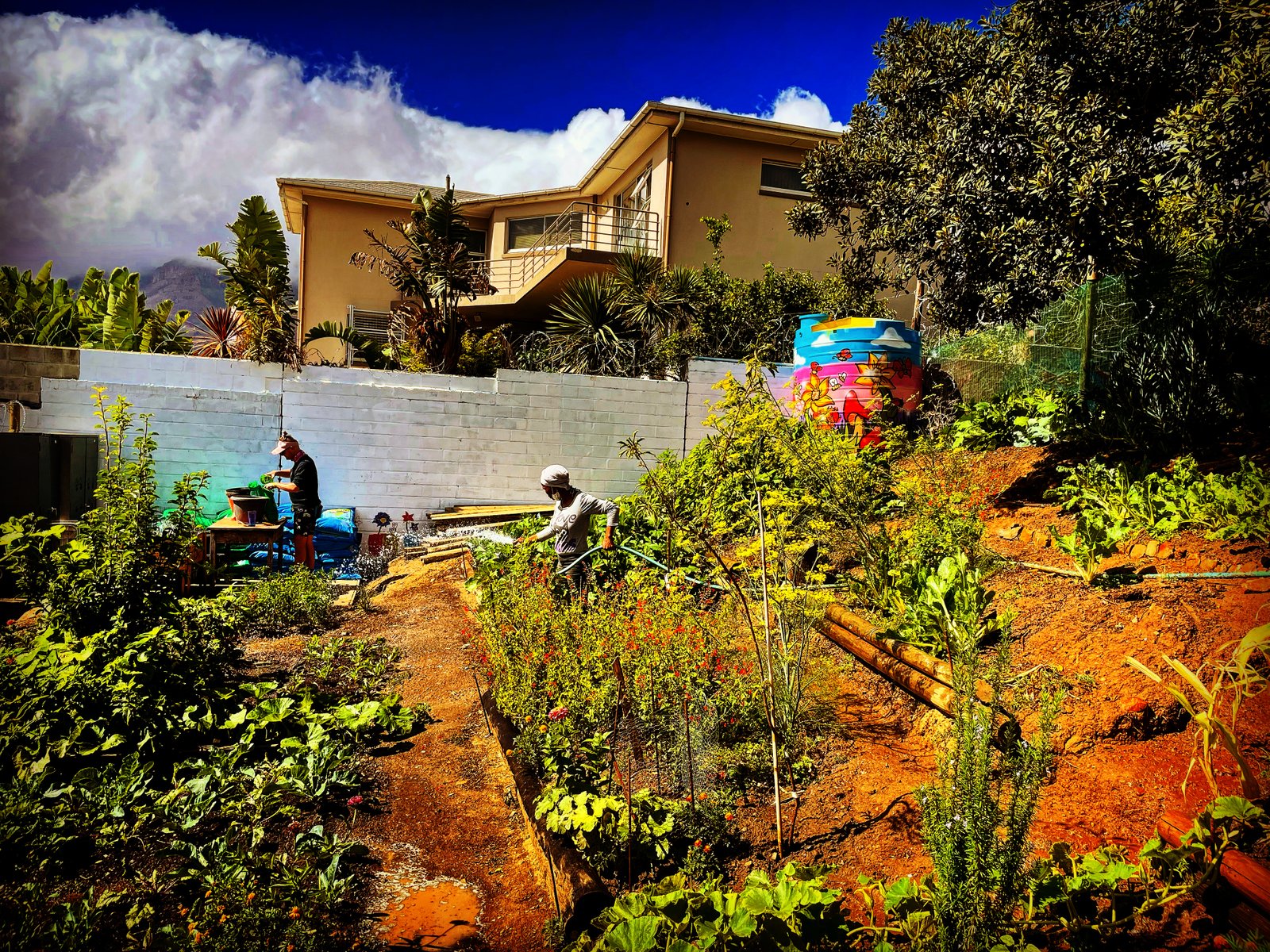 Hans Moolman (left) and Warda Adams tend the Upper Leeuwen Park community garden. (Photograph: Telford Vice)
Telford Vice | Cape Town
ABIEDA Charles was nervous. A man she did not know was following her, albeit at a distance. He was tall and strong, and disconcertingly serious. She was relieved when she reached the doorstep of her home in the Bo-Kaap without being accosted. But there he was behind her, tall and strong and serious.
“This is my house,” she said to the stranger, hoping that would scare him off.
“We can help you,” he said, his suddenly sunny face melting into a broad smile.
Werner Goerke is a 1.93-metre tall, strong, sometimes serious, and a newspaper reader. When he learnt from the pages of the Atlantic Sun about the plight of the Bo-Kaap Helpers, a non-profit group that manages a community garden set within Upper Leeuwen Park, which houses a playground and learning centre for young children who use the garden for some of their lessons, he knew something needed to be done.
By the time the report appeared, in December last year, the garden had been burgled nine times, mostly for its equipment. Thieves had struck for the 10th time by the time Goerke followed Charles home. By then, not even the worm farms were safe. They were smashed and their contents strewn across beds meant to grow food for all who need it. Charles, a seasoned Bo-Kaap Helper, is a committed, spirited woman, but that sight snapped her resolve: “I didn’t come back to the garden for two-and-a-half months.”
Then Goerke loomed large in the scene, and clearly made a good impression. “Immediately, I knew this was help,” Charles said about her doorstep interaction. Goerke was confident about his offer because he wouldn’t be alone. Remember, he said, “We can help you.” He didn’t say I.
Goerke is a beneficiary of Souper Troopers, which began in June 2014 from the boot of founder Kerry Hoffman’s car as an informal feeding scheme in the Company’s Garden. It has grown into one of the most respected organisations focused on improving the lives of Cape Town’s residents who have been afflicted by homelessness.
Goerke knew he could count on himself and his fellow Troopers to turn the garden back into a space where food and hope flourished. And so they have. On a bright, breezy February morning, members of the Souper Squad — a 25-strong group of beneficiaries who have been vetted and employed by Souper Troopers with the help of funding from the city government — met Charles at the garden’s gates. The order of the day’s business was discussed, briefly and informally, and the weeding, watering, planting and pruning was soon underway. That has been the routine, Monday to Thursday, since January.
No-one seemed to tell anyone what to do. But things were done, and with care and enthusiasm. In a world that runs relentlessly on ruthlessly transactional relationships, seeing people do their jobs — some of them arduous, like pushing a wheelbarrow filled with soil upward along a single row of bricks bordering a steep staircase — organically, efficiently and not under instruction, was therapeutic. Out in the fresh air and warming sun, watching one form of life tend to another, it was impossible not to feel good. Had a kind of magic come over the scene? A sprinkling of the fairy dust of human kindness?
Even after all these weeks, Charles is still touched by what she sees in this beautiful space. “You learn about karma and what is ordained for you,” she said with shining, gently wet eyes beaming out from beneath her headscarf. “Because what has happened here was not just about the garden. It was also about me as a person …” She paused to find the words to say what she felt. A tear found its way onto her apron before she did: “We cannot just hold onto the blessings. We must send them on.”
That philosophy is shared by Souper Troopers, and by their beneficiaries. “Being part of Souper Troopers makes me think differently,” Emile Lesch said between watering stints. Lesch has sharp features and sharper eyes, and he chisels his thoughts into even sharper words. “I can see that I’m doing better things than I used to. It’s better than stealing and robbing and walking up and down the street looking in rubbish bins. Here we learn; to work, to respect each other, to be honest, to trust each other. It’s a process and a challenge, but they don’t give up on us. They want us to transform ourselves, but they’re giving us the guidelines to be able to do so. Everything takes time, but it’s working.”
The privileged, who tend to regard the homeless as a blight on their affluence or a cautionary tale of what befalls those who don’t follow the establishment’s dictates, would be surprised to learn that Lesch doesn’t hold them in high regard: “If people on the street are a problem for people who live in houses — people who are more fortunate — what are they doing about that problem?”
It’s a stinging question that has yet to be properly answered. The number of places in Cape Town’s shelters for people who are homeless is exponentially fewer than there are people who need them. Those places don’t come free. And who among the privileged would put up with rules, ubiquitous in shelters, that rob adults of their agency? Or is this about beggars not being able to be choosers? Without money, are you less human? Even less than human? Or could it be that money robs you of your humanity? The use of the word shelter in this context is itself questionable. Shelter from what? The greed of the rich, and their indifference towards suffering?
“When you don’t have the right clothes and you aren’t able to wash, people look at you differently,” Lesch said. “They talk about you — they don’t have a conversation with you to find out what kind of person you are. If you come from a background of wrongdoing, people will judge you on that.
“On the street, if I have some food and someone else comes and they’re hungry, we share that food. But a person who has money eats a little of his food and wastes the rest. He could have given that food to somebody else.
“I don’t want a lot of money. I just want enough to support my family, and to be secure. And when I’m in front of the game I want to be able to help another person who’s in the same position I’m in now. By giving back, you receive more.”
Lesch’s partner, Warda Adams, is blessed with a warm, bright confidence that tumbles out staccato style as she explains what Souper Troopers means to her: “On the streets there’s no love, there’s no friends. It’s just the one hand washing the other. It’s like we are colleagues. But at Souper Troopers I can share my feelings. They hear my voice. We cry, we laugh. We love each other, like a real family, which I never had. On the street, there’s nothing like that. When we’re not working, I find myself wishing I could go there, just to ease my mind. When I’m sad, I tell my story. And they always listen. Sometimes you just need someone just to listen, not to answer back.”
Adams said she used to drink between 15 and 20 litres of wine a day “to ease the stress” of not having a home. Now she’s down to a single litre. “My family — Souper Troopers — keeps me strong. They don’t say I must stop drinking, but that I should drink less. They believe in me and they give me the power to know I can do it.”
Adams said she finds fulfilment in taking care of the elderly and children. So she wasn’t sure she would take to gardening. The way she wields a hosepipe, with as much authority as precision, says otherwise. “If I was on the street right now I’d be thinking, ‘Which ‘rigting’ [direction] am I going to go now; to go steal, to go pickpocket’. But this is keeping me away from all those bad things and keeping me out of jail.”
It’s doing something else for Hans Moolman: “You’re reaping the blessings from working and being connected to the soil, but the word of mouth is spreading and the ‘tannies’ are bringing things.” For instance, Bo-Kaap Helpers are now providing a cooked lunch for the Souper Squad on Thursdays. Their Squad’s honest toil is being recognised and rewarded.
“You don’t do it because of that,” Moolman said. “You do it because this is the task at hand. It’s amazing how it’s getting a life of its own. It’s a reminder of how we should be living, before we had financial imperatives that said, ‘I do this, you give me that’. What happened to giving freely? I love the Middle Eastern thinking of, ‘You are my guest, therefore you don’t owe me anything. You honour me by giving the privilege of or opportunity to bless you’. Why did we lose sight of that as a society? Let me do something for you because I am, and somehow, without expecting it, it will come back to me in another way.
“When the intentions meet each other halfway, beautiful things can happen. When you’re not attached to what you’re doing, somehow, in that exchange of energy, you get back something that you need. Whether it’s emotional, or spiritual or even mental.”
Christopher Mupangila, whose eyes are as soft as his shoulders are broad, is indeed getting what he needs: “In life everything has to have a purpose. Every time you wake up you have to figure out what that purpose is, and Souper Troopers gives us a purpose. Coming here to work in the garden has given us a better understanding of ourselves. Being well received by the community gives us recognition for what we’re here to do.”
These people are not problems. They are assets. They have the hearts, minds, bodies and motivation to make Cape Town a better place for all who live in it. If more Capetonians did so, it would be that better place. Instead, our city is a model of inequality writ large on the street.
But to end this story on a sour note would be to do the Souper Squad a disservice, and they deserve better than that. So here is the sweetest of pictures, as painted by Mupangila.
“Being part of Souper Troopers is a gift,” he said, leaning against a set of swings in the park. He might have left his words there, warm in the summery air. But, for Mupangila, they weren’t quite enough. So he added a touch more hope: “It’s a gift I’m still unwrapping.”
An edited version of this piece was first published in DM168 on March 12, 2022.
Comments
No comments yet. Start the conversation.